The boardroom buzz around Artificial Intelligence is deafening. Executives in finance, healthcare, and insurance are under immense pressure to deploy AI, with the promise of unlocking unprecedented efficiency, groundbreaking insights, and new revenue streams. Yet, for all the multi-million dollar investments, a stark reality persists: a staggering number of data analytics and AI projects fail to deliver their intended business value.
Many of these initiatives stall in “pilot purgatory,” never moving from a data scientist’s laptop to live production. Others deploy but fail to produce a meaningful return on investment (ROI), or worse, create new compliance and security risks.
This isn’t a technology failure; it’s a foundation failure.
Organizations are buying complex, expensive AI tools before they have built a foundation capable of supporting them. True AI readiness isn’t a piece of software you buy; it’s a strategic, end-to-end framework. It’s the unglamorous-but-essential plumbing, governance, and talent infrastructure that separates wishful thinking from transformative results.
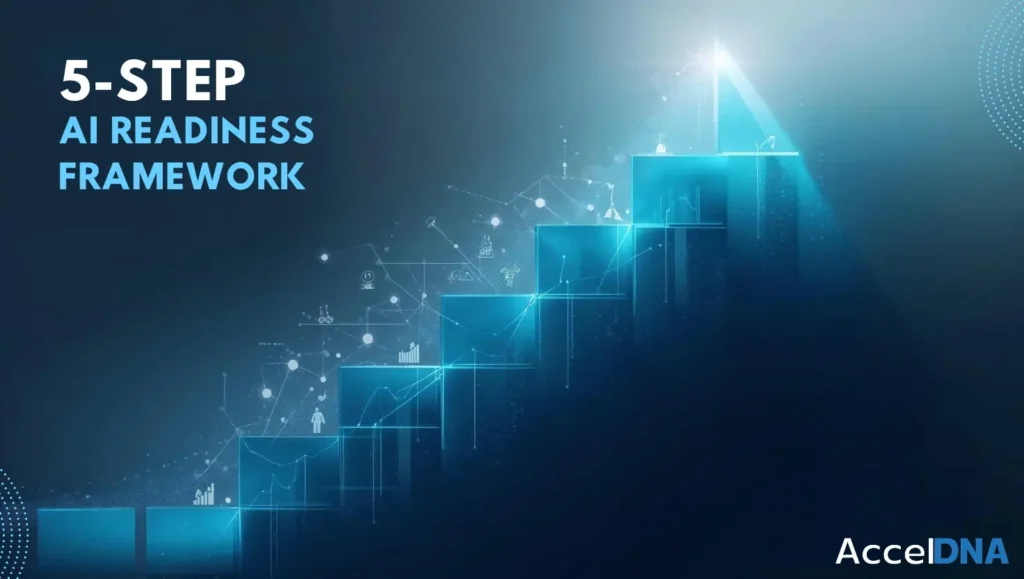
For leaders tasked with navigating this high-stakes landscape, here is a 5-step, business-first framework to move from AI hype to scalable, in-production AI that delivers real value.
Step 1: The “Honest Audit” – Assessing Your Data Management Foundation
You cannot build a skyscraper on a weak foundation. The first, most critical step toward AI readiness is an honest, unflinching audit of your current data landscape. For many established organizations, this means confronting decades of siloed data and technical debt.
Evaluating Your Strategic Data Management Maturity
For decades, data in finance and healthcare was treated as an operational by-product, an exhaust file from a transaction, a patient record, or a claim. It was stored in disconnected, departmental “silos,” often in formats that were incompatible with one another. This siloed approach is the single greatest barrier to advanced analytics.
A mature Strategic Data Management program treats data as a unified, core business asset, just like your capital or your people. This audit must ask the hard questions:
- Where does our most critical data live?
- Who “owns” it, and who is responsible for its quality?
- Is it secure, and can we prove it?
- Is it accessible to the teams who need it, or is it locked in a legacy system?
Confronting Legacy Systems and Technical Debt
In highly regulated industries, legacy systems are the elephants in the room. These older platforms, while often reliable for their original purpose, are brittle, expensive to maintain, and were never designed for the demands of modern data analytics.
Your AI ambitions are directly chained to your technical debt. A proper audit must quantify the cost of inaction. It’s common to find that 70-80% of an IT budget is consumed just by “keeping the lights on” for these legacy systems, starving new AI initiatives of the capital and resources they need to succeed.
Linking Data to Business Outcomes
An audit without a goal is just an inventory. The final part of this step is to map your data assets to specific business outcomes. Before you can implement AI, you must know what you are trying to fix or improve.
- For a healthcare exec: Which data streams impact patient readmission rates or claims processing time?
- For a financial exec: Where is the data needed for real-time fraud detection or algorithmic credit risk assessment?
This mapping exercise creates a “value chain” for your data, identifying the assets that will fuel your most important AI projects.
Step 2: The “Rulebook” – Implementing Enterprise Data Governance
Now that you know what data you have, where it is, and what it’s for, you must make it trustworthy. This is the most misunderstood and most critical step in any AI journey.
Many leaders see governance as a defensive “cost center,” a bureaucratic set of rules designed to slow things down. This is fundamentally incorrect. A reactive, check-the-box governance policy paralyzes innovation.
In contrast, a proactive Enterprise Data Governance framework is the single greatest accelerator for AI. It creates a “single source of truth,” a trusted, secure, and auditable data foundation that gives your teams the confidence to build, deploy, and scale models with speed.
Key Pillars: Data Quality, Lineage, and Security
A robust data governance framework is built on three pillars that are non-negotiable for AI readiness.
Data Quality
You cannot have “smart AI” with “dumb data.” Period. An AI model trained on incomplete, inaccurate, or biased data will only amplify those flaws, automating bad decisions at a massive scale. Governance establishes the rules, processes, and tools to ensure data is clean, consistent, and complete before it ever reaches a data scientist.
Data Lineage
In a regulated world, “the computer said so” is not a defensible answer. Data lineage provides a verifiable, end-to-end audit trail of your data where it originated, how it was transformed, and who accessed it. For a financial institution facing an audit or a healthcare provider justifying a treatment model, this immutable record of provenance is an absolute necessity.
Security & Compliance
This pillar aligns your data strategy with legal and ethical mandates. For healthcare leaders, this means a governance framework built from the ground up for HIPAA compliance, ensuring the protection of patient data at every stage. For financial institutions, it means robust controls for SOX, CCPA, and GDPR, ensuring that your data-driven innovations don’t create costly new liabilities.
Without governance, data scientists can spend up to 80% of their time just finding and cleaning data. With a strong governance program, they can spend that time building the models that drive your business forward.
Step 3: The “Factory” – Engineering Your MLOps Implementation Pipeline
If data governance provides high-quality raw materials, MLOps Implementation (Machine Learning Operations) is the automated factory.
This is the technical solution to the “pilot purgatory” problem. Countless organizations have promising AI models stuck in this state of perpetual testing, unable to leap from a single laptop to an enterprise-wide application. The reason is often a manual, broken handoff between the data science team (who builds the model) and the IT operations team (who has to run it).
What is MLOps (and Why It’s Non-Negotiable)
MLOps is a set of practices that does for AI what DevOps did for software: it makes the process of deploying, managing, and monitoring models reliable, repeatable, and scalable. It is the engine that moves models from pilot to production.
A mature MLOps pipeline automates the entire AI lifecycle, including:
Continuous Integration/Continuous Deployment (CI/CD)
A standardized, automated process for testing and deploying new models without disrupting business operations.
Active Monitoring
AI models are not static. They can “drift” as new, real-world data deviates from the data they were trained on. MLOps actively monitors model performance and accuracy, flagging them for review before they cause a problem.
Automated Retraining
When a model drifts, MLOps provides the framework to automatically retrain it on new, fresh data and redeploy it, ensuring your AI applications are always learning and adapting.
Building a Scalable AI Implementation Framework
You are not just building one AI model. You are building an enterprise capability. A mature AI Implementation Framework built on MLOps principles is a central, reusable platform. It makes deploying your tenth model 100 times easier and faster than deploying your first, allowing you to rapidly scale AI solutions across your entire organization.
Step 4: The “A-Team” – Solving the AI Talent Gap
Your foundation is set, and your factory is built. Now you need expert operators. This is often the most significant challenge. The “AI talent gap” is real, and the competition for specialized skills in data engineering, governance, and MLOps is fierce.
The default strategy, competing with every other bank, hospital, and tech giant for the same handful of elite, expensive data scientists, is broken. It’s too slow and too costly.
The “Build vs. Buy” Myth: You Must Do Both
A modern, resilient AI talent strategy is a hybrid one. It recognizes that you cannot hire your way out of this problem. The solution is a “Talent Portfolio” that balances internal development with strategic external expertise.
Upskilling & Training (Your Hidden Asset)
Your organization’s hidden goldmine is its existing workforce. Your current business analysts, IT staff, and compliance officers possess decades of invaluable domain expertise. This business context is often harder to teach than new technical skills. A targeted training and upskilling program can transform these domain experts into a powerful, data-literate workforce.
Strategic Staffing (Your Accelerator)
A flexible staffing model allows you to accelerate your roadmap from years to months. Strategic staffing (whether onshore, nearshore, or offshore) is not about replacing your team; it’s about augmenting it. It allows you to inject specialized, high-demand skills, like an MLOps engineer or a data governance expert, precisely when you need them for a critical project, transferring knowledge to your internal team in the process. This hybrid approach is the most cost-effective and practical way to solve the AI talent gap.
Step 5: The “Flywheel” – Prioritizing AI Projects for Maximum ROI
You have the foundation, the factory, and the team. The final step is to apply them with surgical precision. To get executive buy-in and fund future innovation, you must start with the right projects.
How to Identify High-Impact “First Wins”
Don’t try to “boil the ocean” with a massive, multi-year “transformation” project that has an unclear outcome. Instead, target a high-impact, high-visibility “first win” with a clear, measurable outcome.
- In healthcare: Start by automating prior authorization or building a predictive model for patient readmission risk.
- In finance: Focus on streamlining fraud detection in real-time or automating regulatory reporting.
- In insurance: Implement an AI-driven underwriting model or an intelligent claims processing system.
Successfully delivering one of these projects builds invaluable institutional momentum and proves the business case for AI.
Measuring Success: Tying AI Metrics to Business KPIs
The success of an AI project is not “model accuracy” or “processing speed,” those are technical metrics. The success of an AI project is a business metric.
True AI Project ROI is measured in terms of “reduced operational cost,” “new revenue generated,” “decreased claims fraud,” or “improved patient outcomes.” By tying your AI initiatives directly to the core KPIs of the business, you complete the “flywheel,” using the value from your first project to fund the next, more ambitious one.
Conclusion: Your Future is AI-Ready. Is Your Foundation?
True AI readiness is not a single product you can buy or a single data scientist you can hire.
It is a continuous, holistic “flywheel” that begins with a foundation of Strategic Data Management, is accelerated by proactive Enterprise Data Governance, is brought to life by a scalable MLOps Implementation pipeline, and is run by a hybrid Talent strategy.
Building this AI-ready foundation is precisely where Accel DNA partners with executive leaders. We provide expert consulting to build your framework and the specialized staffing and training to power it.
Ready to move from hype to reality?